

Sail VR
- Meta Quest Store:
- 2.45M+
- Engine: Unity
- Role: Systems Designer
- Team Size: 6
- Studio: Continuum XR
- Genre: Open-World / Action-Adventure / Roguelite
- Type: VR
You are a disgraced pirate clawing your way back to infamy. Every voyage is a thrilling bet on how much gold you dare to carry at sea.
- Wealth draws danger. The more gold you carry, the bigger the bounty on your head and the harder the world hunts you.
- Gold only counts once it’s home. Die at sea and you lose everything you carried on that run.
- Risk rewards reputation. Rank comes from daring, not from time spent.
- You decide when to cash out. There’s no timer. Each player chooses when to push further and when to head home.
1. Risk & Reward System
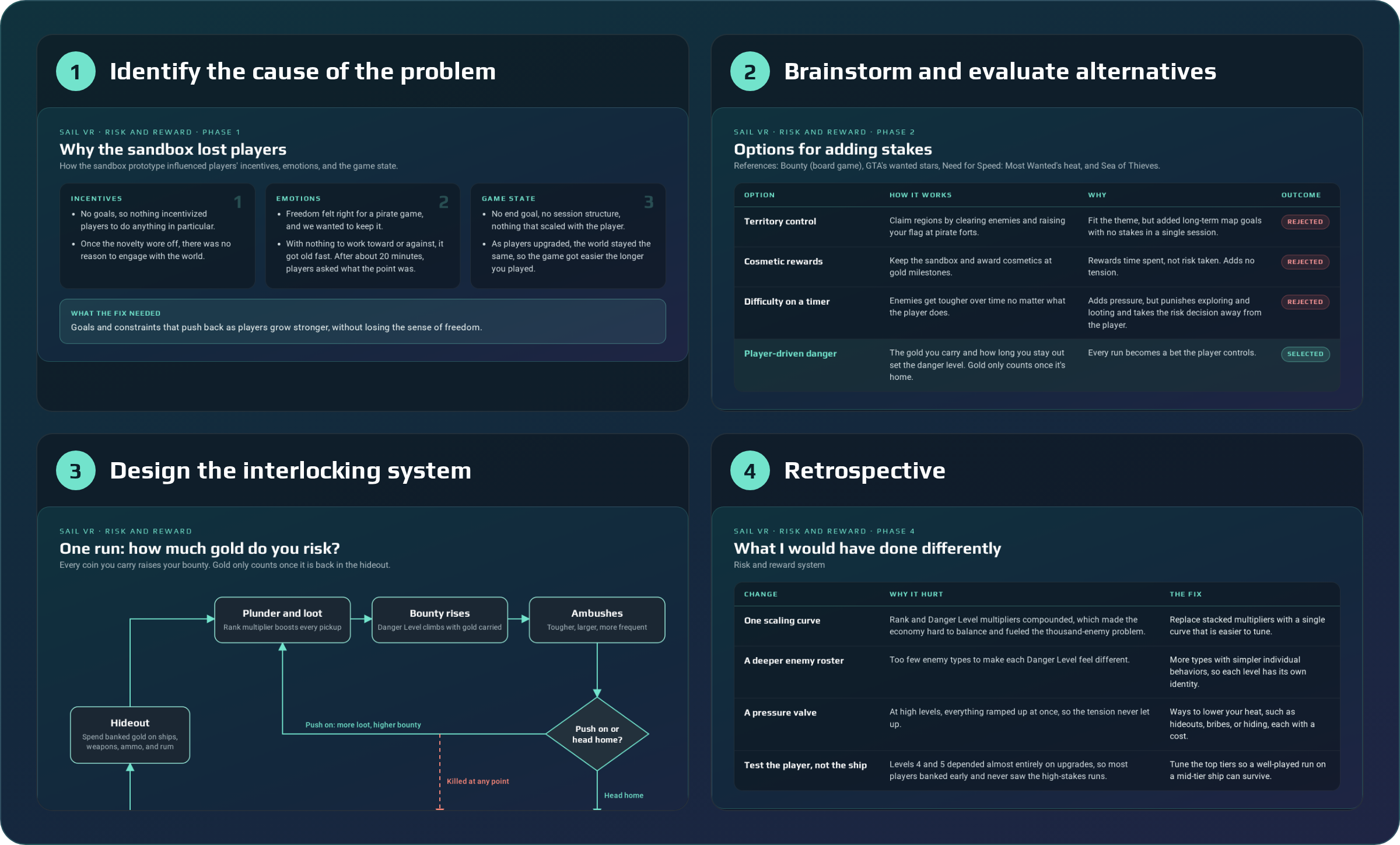
I looked at how the sandbox prototype influenced players’ incentives, emotions, and how it impacted the game state.
- Incentives: As a sandbox with no goals, the game didn’t incentivize players to do anything in particular. Once the novelty wore off, players had no reason to engage meaningfully with the world.
- Emotions: The sandbox gave players a sense of freedom. That felt right for a pirate game, and we wanted to keep it. But fun usually comes from constraints. With nothing to work toward or against, the freedom got old fast: after about 20 minutes, players started asking what the point was.
- Game state: The world had no end goal, no session structure, and nothing that scaled with the player. As players upgraded, the world stayed the same, so the game got easier the longer you played.
The prototype needed goals and constraints that pushed back as players grew stronger, without losing the sense of freedom.
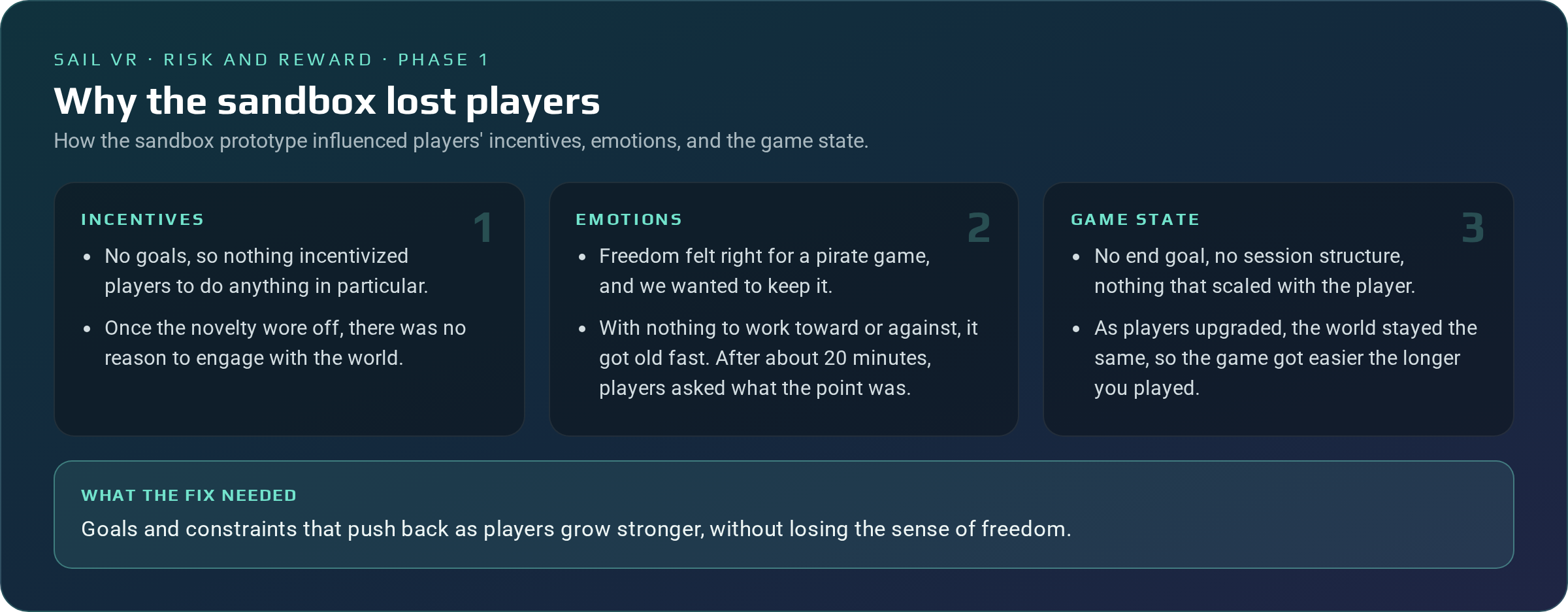
- References:
- Bounty, the board game: you only keep the gold you bring home.
- GTA’s wanted stars and the heat system in Need for Speed: Most Wanted: danger that responds to what you do.
- Sea of Thieves: open-world sailing and treasure.
- Territory control: Players claim regions by clearing enemies and raising their flag at pirate forts. It fit the theme, but it created long-term map goals without adding any stakes to a single session. Rejected.
- Cosmetic rewards for gold milestones: Keep the sandbox and award cosmetics at gold thresholds. This rewards time spent, not risk taken, and adds no tension. Rejected.
- Difficulty that rises on a timer: Enemies get tougher over time no matter what the player does. It adds pressure, but it punishes exploring and looting and takes the risk decision away from the player. Rejected.
- Selected, player-driven danger: How much gold you carry and how long you stay out set the danger level, and gold only counts once it’s home.
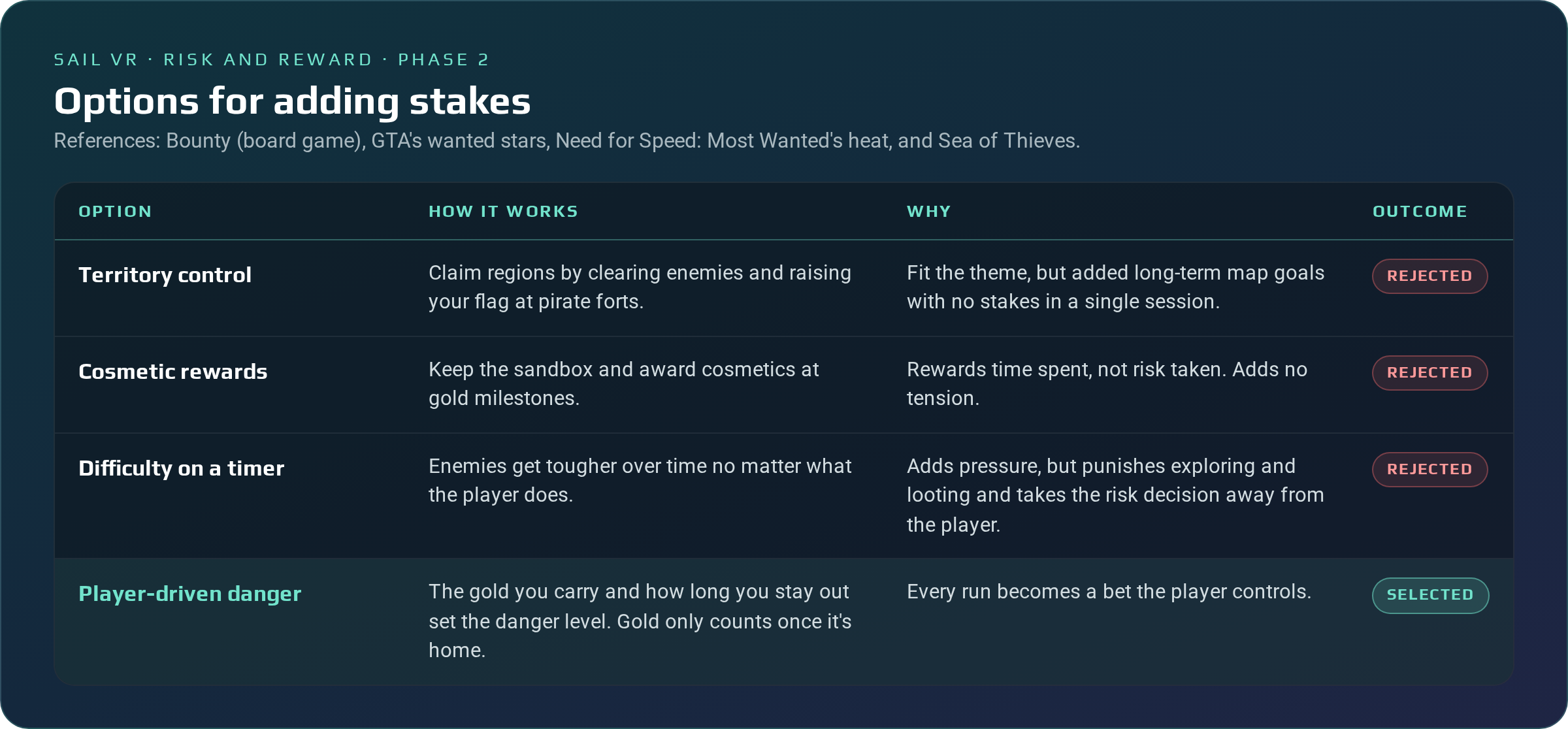
I designed three systems that feed into each other, each built on one of the pillars.
- Player Ranks (risk rewards reputation)
- Robbing a convenience store and pulling off a bank heist both steal money, but only one makes the news. Ranks work the same way: a Scallywag loots barrels, and a Pirate King pulls off runs the whole world hears about.
- To promote from Scallywag through Privateer, Buccaneer, and Captain up to Pirate King, you had to collect that rank’s gold target in a single run and make it home alive.
- Each rank raised your permanent gold multiplier, from x1 to x5, and unlocked bigger ships and better weapons. Gold targets grew much faster than the multipliers, so every promotion run put more on the line.
- Danger Level (wealth draws danger)
- Danger sits at 0 while you carry no gold. The first coin you loot raises it to 1, and each larger gold threshold raises it again, up to 5.
- Each level adds a new land enemy and a new sea enemy, larger ambushes, and shorter gaps between them. It also adds a gold multiplier on top of your rank bonus.
- Enemy ambushes (gold only counts once it’s home)
- The first version was a point-buy system. The game spent the gold you were carrying to hire enemies, each with a set cost. Because the gold multipliers stacked, carried gold grew so fast that the game would try to spawn a thousand enemies in a single ambush.
- A thousand enemies would have tanked performance and made for a miserable experience, so I capped enemy count and switched to a composition system. Danger Level sets which enemy types can appear, and higher levels raise the odds of larger ambushes with more tough enemies in the mix.
- A new ambush can arrive before you’ve cleared the last one, so every extra minute at sea raises the risk.
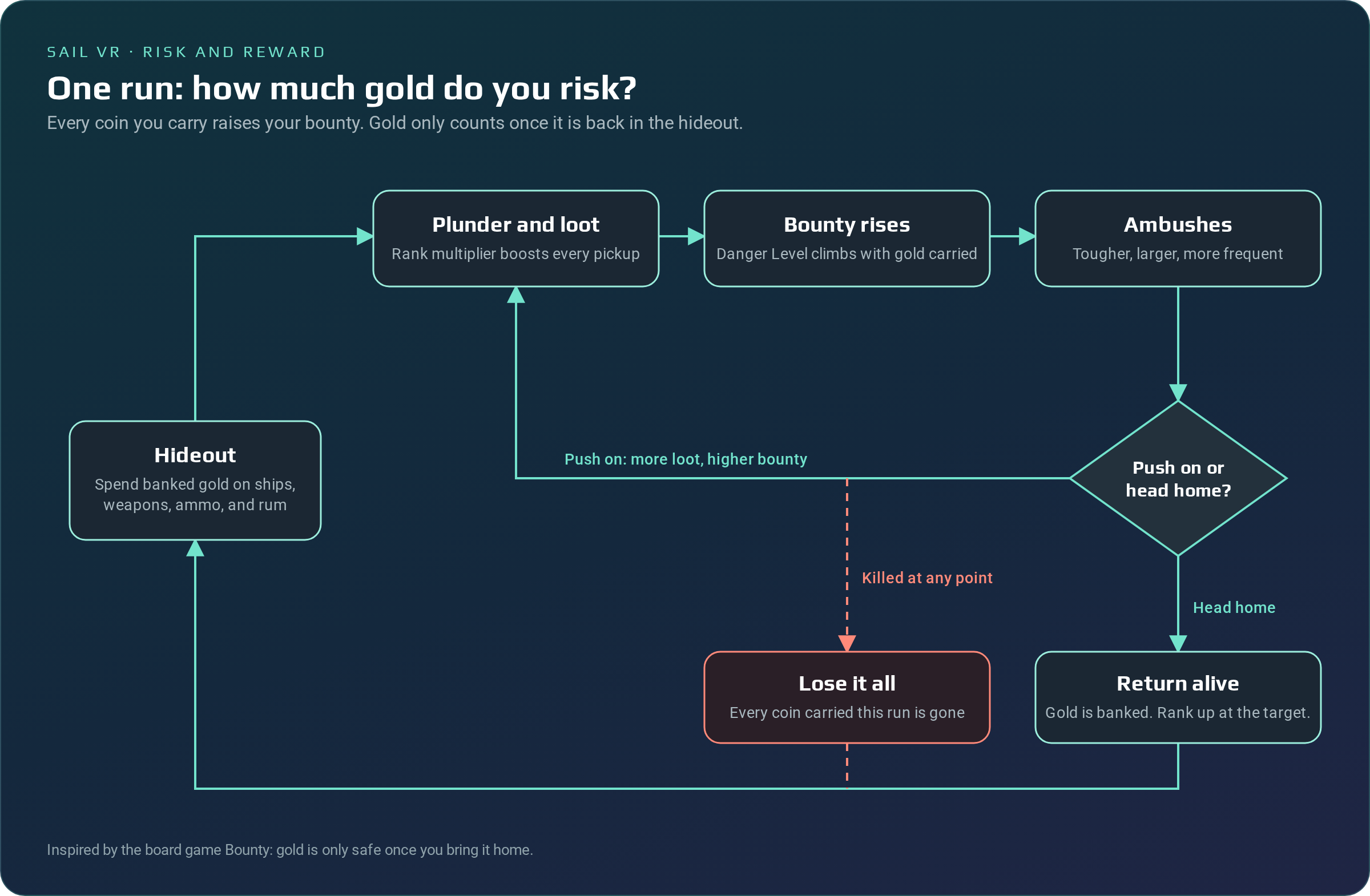
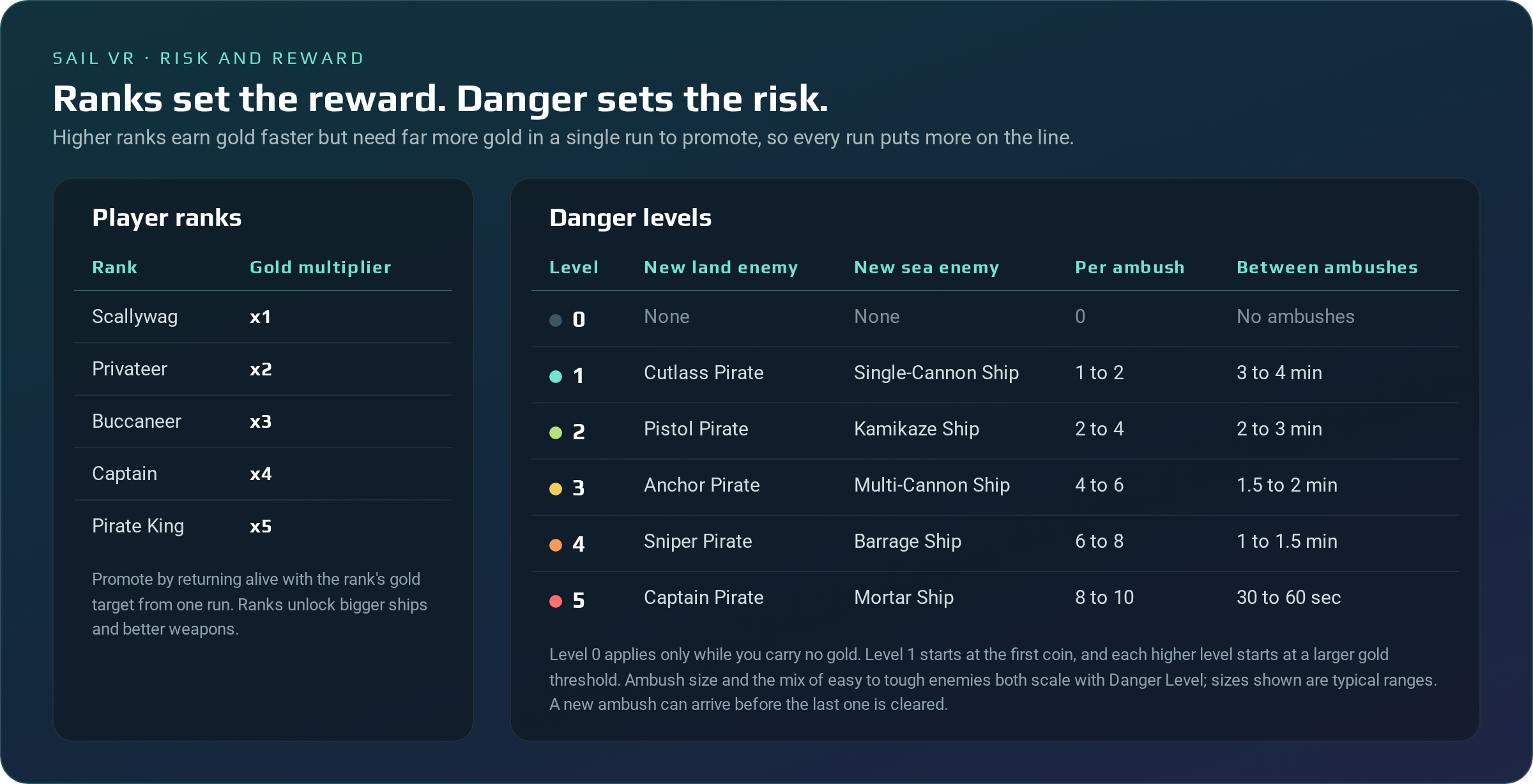
What worked: The system made players feel hunted. At the highest Danger Levels, no one could clear the waves, because a new one arrived before the last was gone. Players ran for their lives while every kill and every sunken ship paid out a fortune. Escaping with a huge haul was one of the best moments in the game.
What I would have done differently:
- One scaling curve instead of stacked multipliers. Rank and Danger Level multipliers compounded, which made the economy hard to balance and fueled the thousand-enemy problem. A single curve would have been easier to tune.
- A deeper enemy roster. There weren’t enough enemy types to make each Danger Level feel different. More types with simpler individual behaviors would have given each level its own identity.
- A pressure valve. At high levels, new enemy types, more frequent ambushes, and bigger multipliers all ramped up at once, so the tension never let up. Tension needs moments of relief to land. I’d add ways to lower your heat, such as hideouts, bribes, or hiding, each with a cost so every voyage stays a bet.
- Top tiers that test the player, not just their ship. Surviving Levels 4 and 5 depended almost entirely on upgrades. Without a fully upgraded ship, players almost certainly died, and since dying meant losing everything, the smart play for most was to bank early. Most players never experienced the high-stakes runs the system was built for. I’d tune the top tiers so a well-played run on a mid-tier ship could survive, making upgrades an advantage rather than a requirement.
2. Naval Combat System
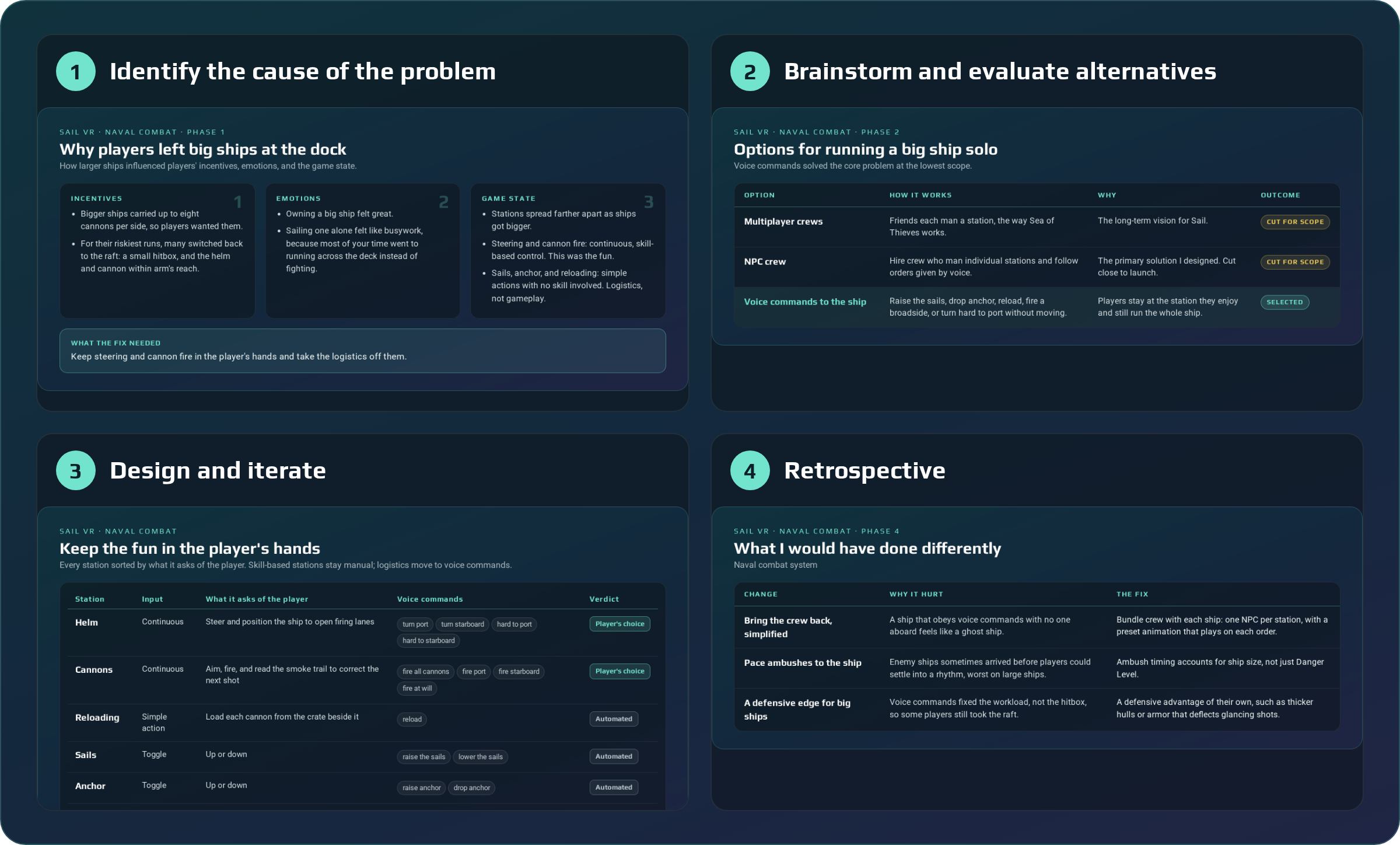
I looked at how larger ships influenced players’ incentives, emotions, and how they impacted the game state.
-
Incentives: Bigger ships carried up to eight cannons per side and dealt far more damage, so players wanted them. But for their riskiest runs, many players switched back to the raft. Its small hitbox made enemy fire easier to dodge, and its helm and single cannon sat within arm’s reach, so you could steer with one hand and fire with the other.
-
Emotions: Owning a big ship felt great. Sailing one alone felt like busywork, because most of your time went to running across the deck instead of fighting.
-
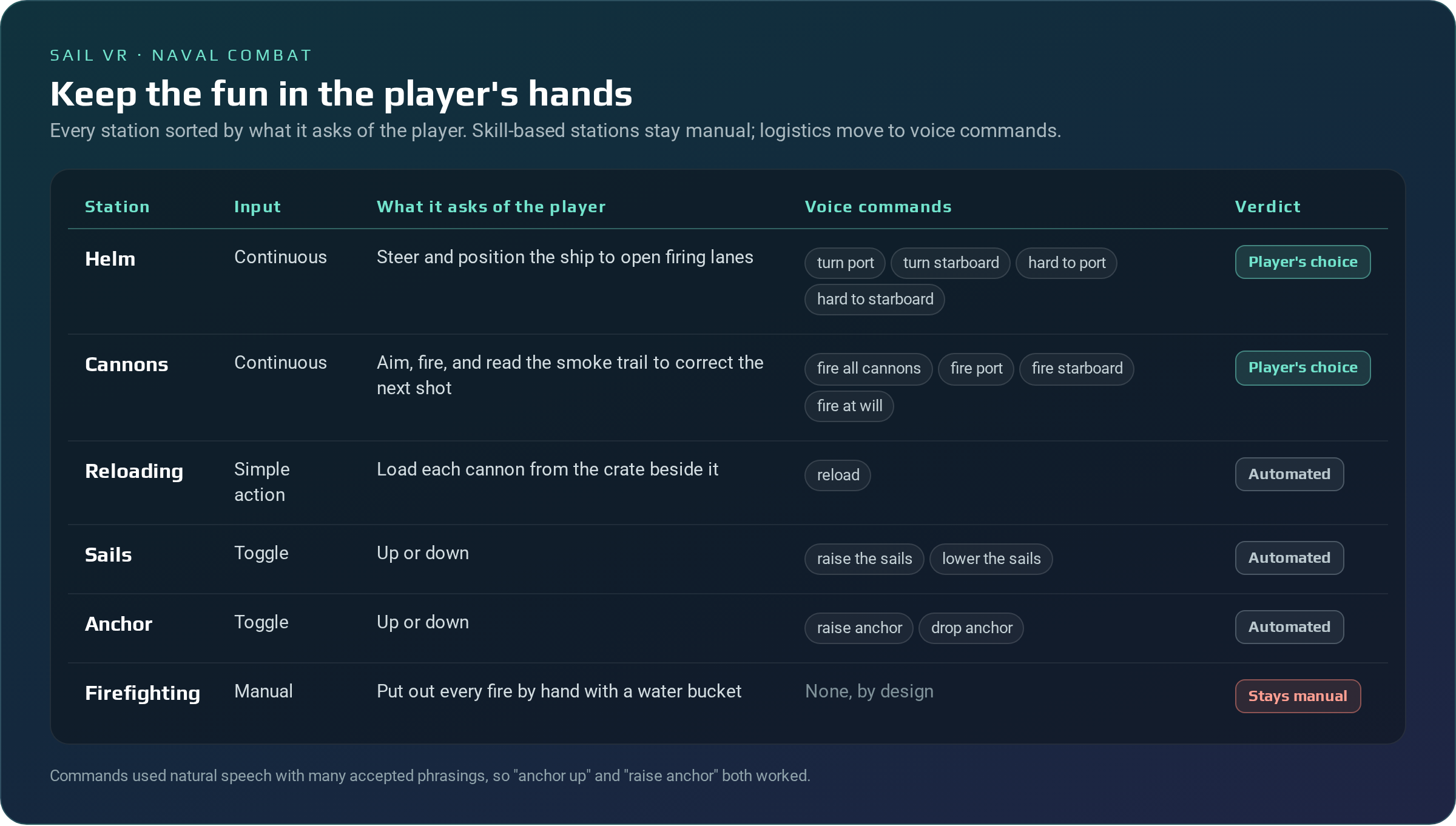
Game state: Stations spread farther apart as ships got bigger. I sorted every station by the kind of input it asked for:
- Steering and cannon fire: continuous, skill-based control. This was the fun.
- Sails, anchor, and reloading: simple actions with no skill involved. Logistics, not gameplay.
On large ships, the logistics took up most of the player’s time and movement.
When players left their best ship at the dock for their most important runs, the upgrade path was working against itself. The fix had to keep steering and cannon fire in the player’s hands and take the logistics off them.
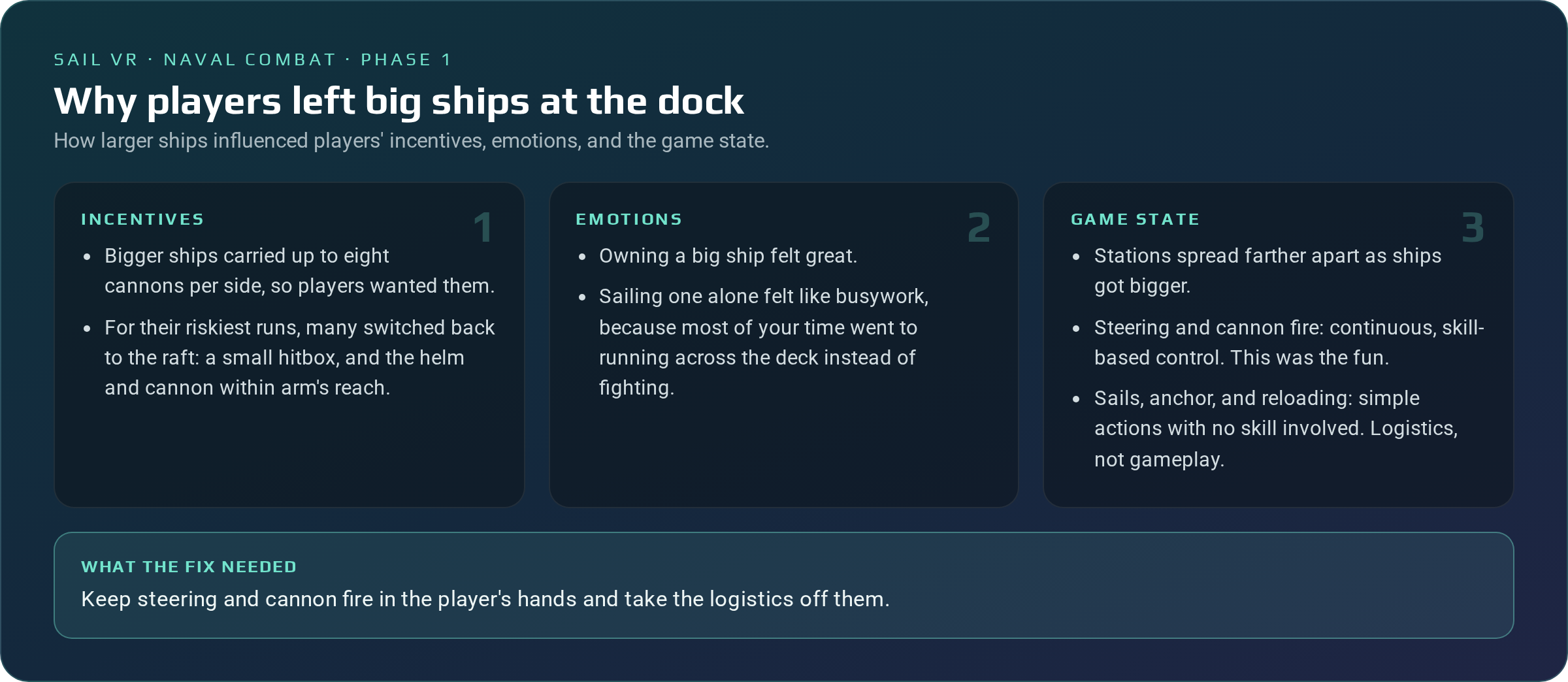
- Multiplayer crews: Friends each man a station, the way Sea of Thieves works. This was the long-term vision for Sail, but it was cut for scope.
- NPC crew: Players hire crew members who man individual stations and follow orders. This was the primary solution I designed, and voice commands were how you gave the orders. It was cut for scope close to launch.
- Voice commands to the ship: When the crew was cut, I kept the voice commands and pointed them at the ship itself. From whichever station they preferred, players could raise the sails, drop anchor, reload, fire a broadside, or turn hard to port without moving. Selected.
Voice commands solved the core problem at the lowest scope. Players stayed at the station they enjoyed and still ran the whole ship.
-
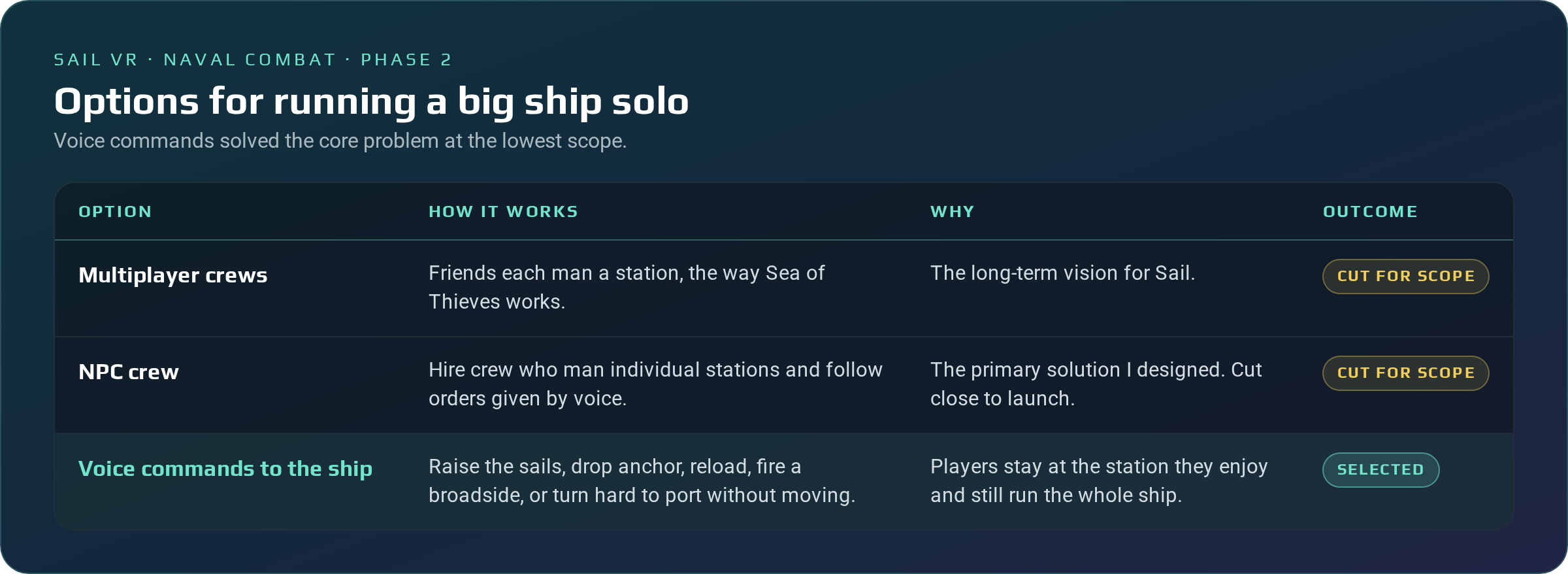
Voice commands for every station. Players spoke naturally, and the game listened for keywords. I wrote a large list of phrasings for every action, so “raise anchor,” “anchor up,” and similar variations all worked. Players never had to remember an exact phrase.
- Sails: raise the sails, lower the sails
- Anchor: raise anchor, drop anchor
- Cannons: reload, fire all cannons, fire port, fire starboard, fire at will
- Helm: turn port, turn starboard, hard to port, hard to starboard
“Fire at will” set the cannons to fire automatically at any target in range. A player at the helm could fight a full battle without touching a cannon, and a player at the cannons could steer without leaving the gun.
-
Cannons worth choosing. For players to pick the cannons as their station, firing had to be fun on its own. Instead of fixed naval mounts, I designed the cannons as free-swiveling turrets that rotate horizontally and vertically. Each cannonball left a smoke trail, so players could read the arc of every shot and correct the next one. Aiming was learnable without a tutorial.
-
Firefighting stays manual. Cannon hits started fires that players had to put out by hand with a water bucket. If the ship could repair itself while it steered and fought on its own, combat would have been too easy. Fires are the one thing that forces the player off their station, and that adds pressure at the right moments.
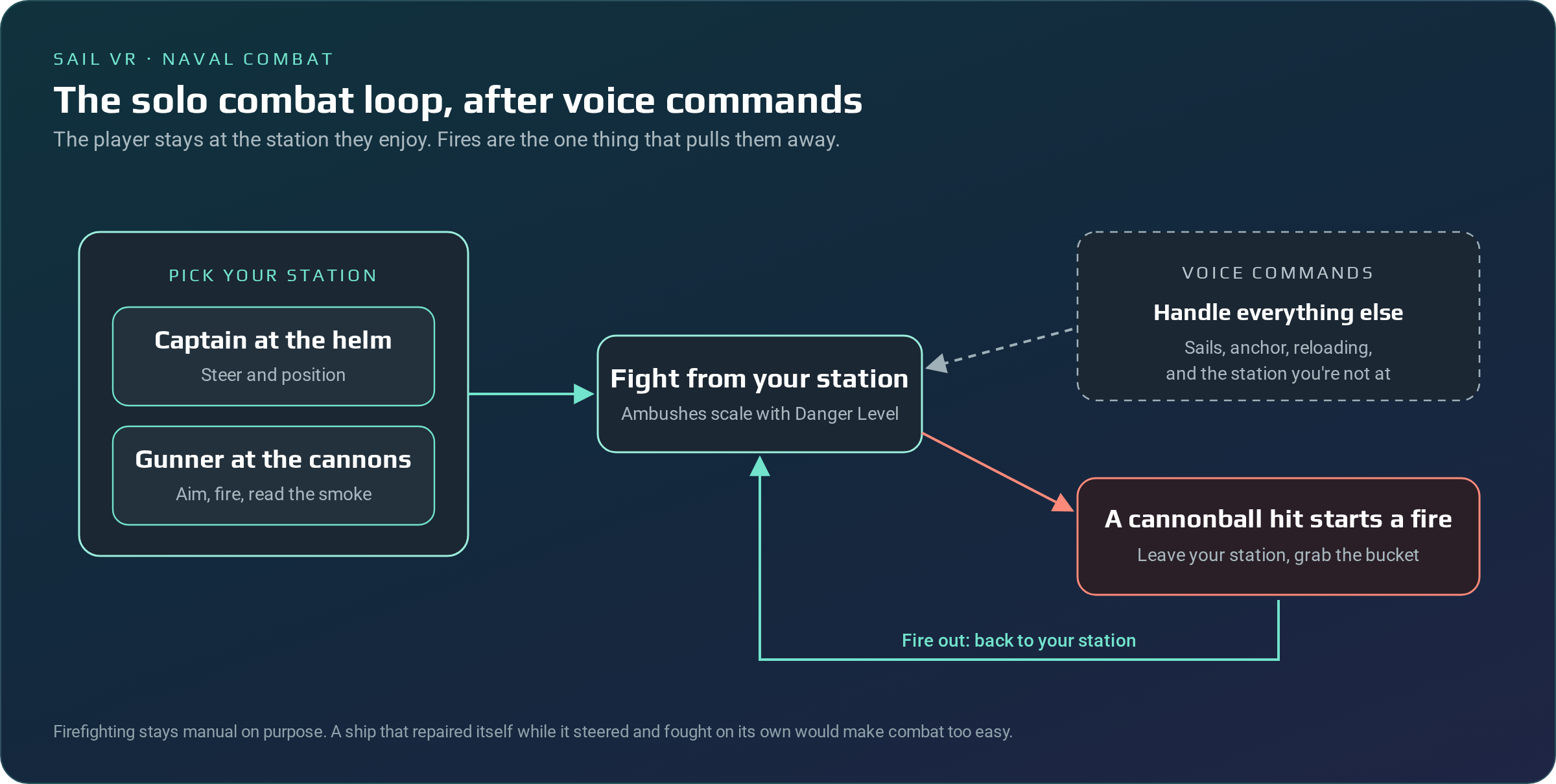
What worked: Large ships became playable solo, and fewer players left them at the dock for their biggest runs. Players could be the captain at the wheel or the gunner at the cannons, and voice commands made either role work. The best moments came when players were surrounded, putting out fires with one hand and returning fire with the other.
What I would have done differently:
- Bring the crew back, simplified. A ship that obeys voice commands with no one aboard feels like a ghost ship. The commands worked, but they needed bodies to sell them. Instead of hireable crew who move around the ship, I’d bundle crew with each ship: one NPC per station, with a preset animation that plays when you give the order. That’s far less scope than roaming crew, and much more immersive.
- Pace ambushes to the ship. Enemy ships sometimes arrived faster than players could settle into a rhythm. This was worst on large ships, where running to put out fires took longer. Ambush timing should account for ship size, not just Danger Level.
- Give big ships a defensive edge. Some players still took the raft on their biggest runs, because its small hitbox made enemy fire easier to dodge. Voice commands fixed the workload, not the hitbox. Large ships needed a defensive advantage of their own, such as thicker hulls or armor that deflects glancing shots, so the upgrade path paid off all the way to the top.
3. Treasure Hunt System
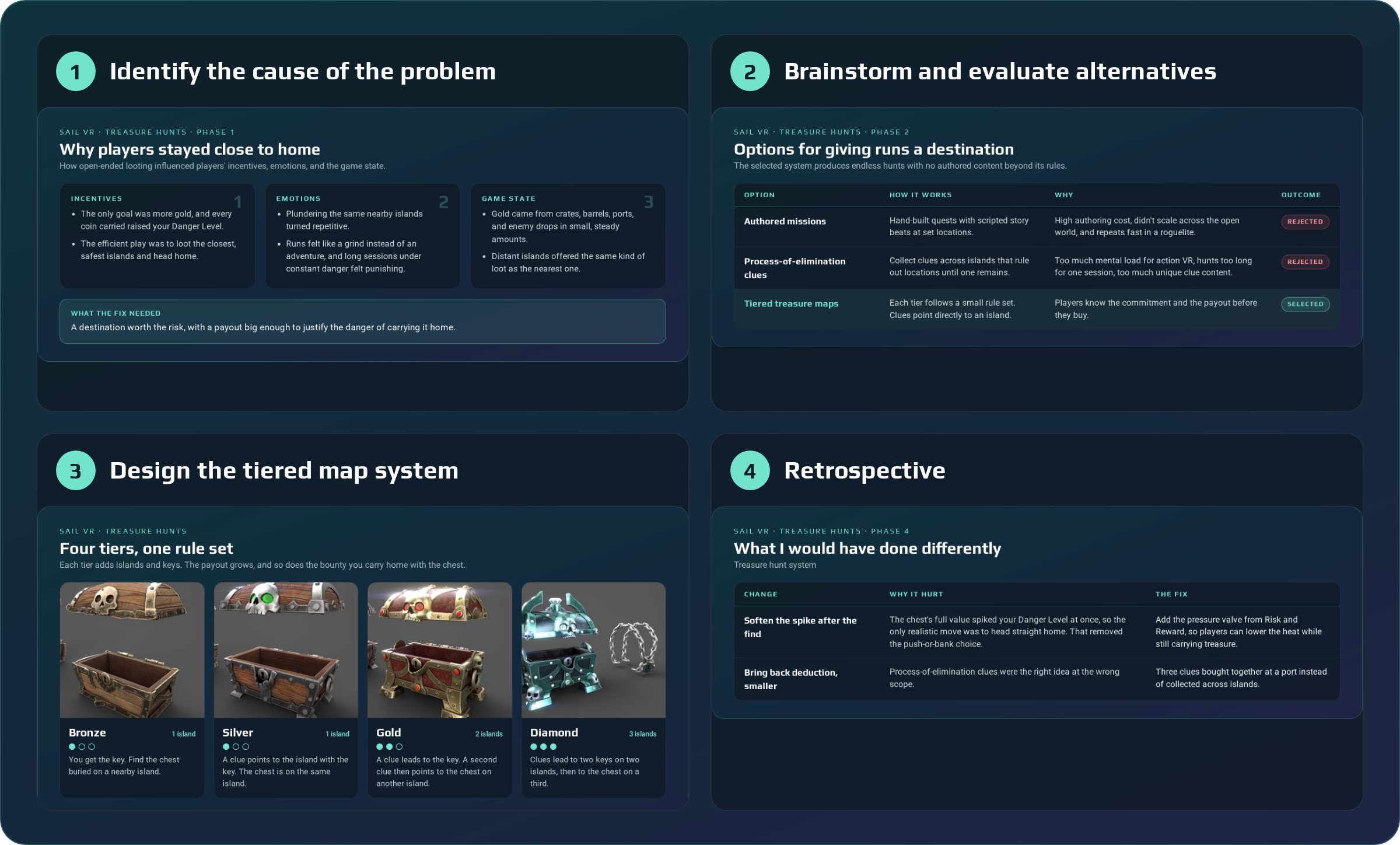
I looked at how open-ended looting influenced players’ incentives, emotions, and how it impacted the game state.
- Incentives: The only goal was more gold, and every coin you carried raised your Danger Level. The efficient play was to loot the closest, safest islands and head home. Nothing rewarded venturing farther.
- Emotions: Plundering the same nearby islands turned repetitive. Runs felt like a grind instead of an adventure, and long looting sessions under constant danger felt punishing rather than rewarding.
- Game state: Gold came from crates, barrels, ports, and enemy drops in small, steady amounts. Distant islands offered the same kind of loot as the nearest one, so there was no reason to make the trip.
Players needed a destination worth the risk: a reason to go somewhere specific, for a payout big enough to justify the danger of carrying it home.
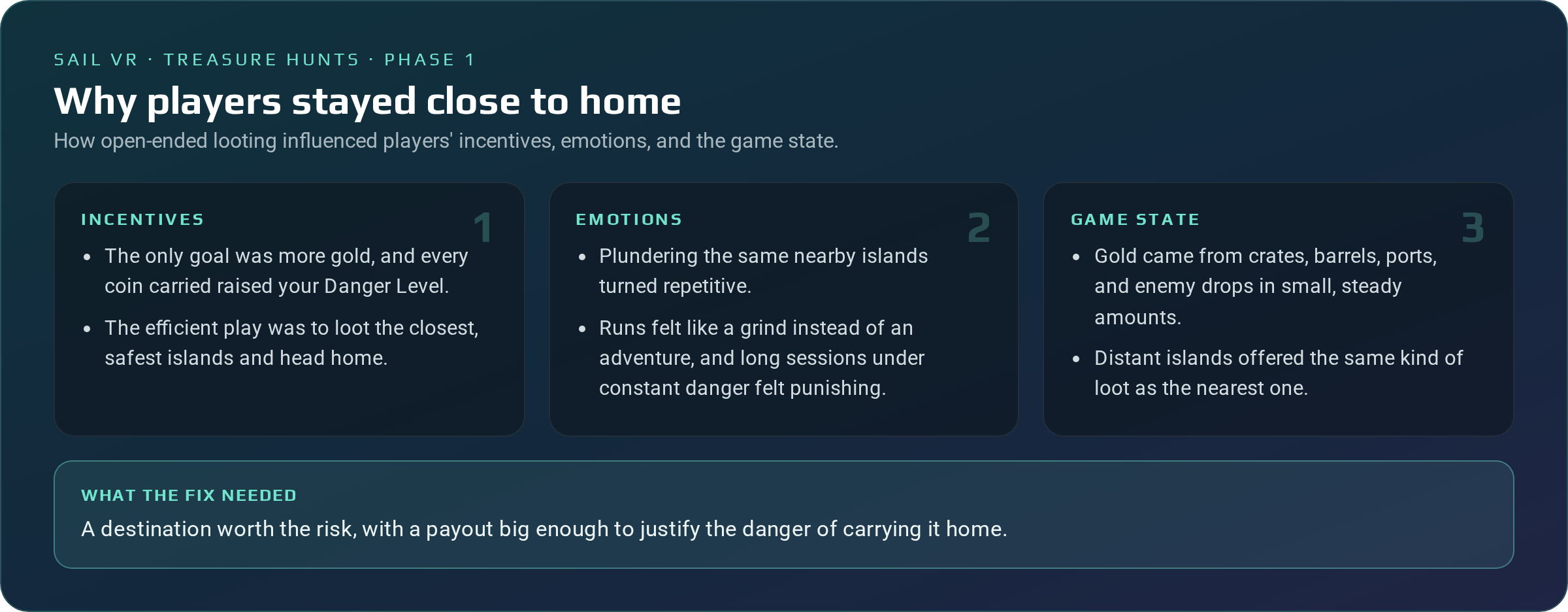
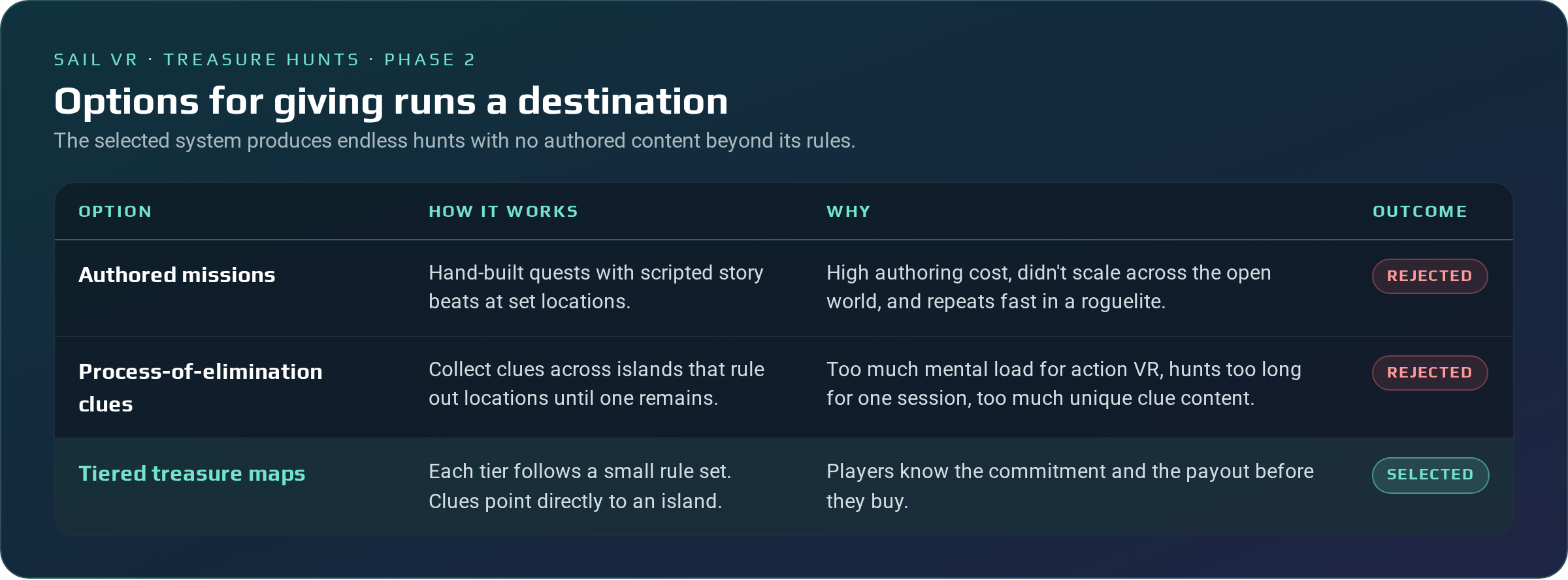
- Authored missions: Hand-built quests with scripted story beats at set locations. Rejected. The authoring cost was high, it wouldn’t scale across the open world, and in a roguelite, authored content repeats and loses its novelty fast.
- Process-of-elimination clues: Players travel between islands collecting clues that rule out locations (“The treasure is not on Skull Island,” “The treasure is not on a large island”) until only one remains. It fit the pirate theme, but it was rejected for three reasons:
- The mental load was too high for an action-focused VR game.
- Sailing between islands made a single hunt too long for one session.
- Every hunt needed too much unique clue content.
- Tiered treasure maps (selected): Every hunt is built from a small set of rules per tier, and players know the commitment and the payout before they buy. Clues point directly to an island instead of ruling islands out. The system produces endless hunts with no authored content beyond the rules themselves.
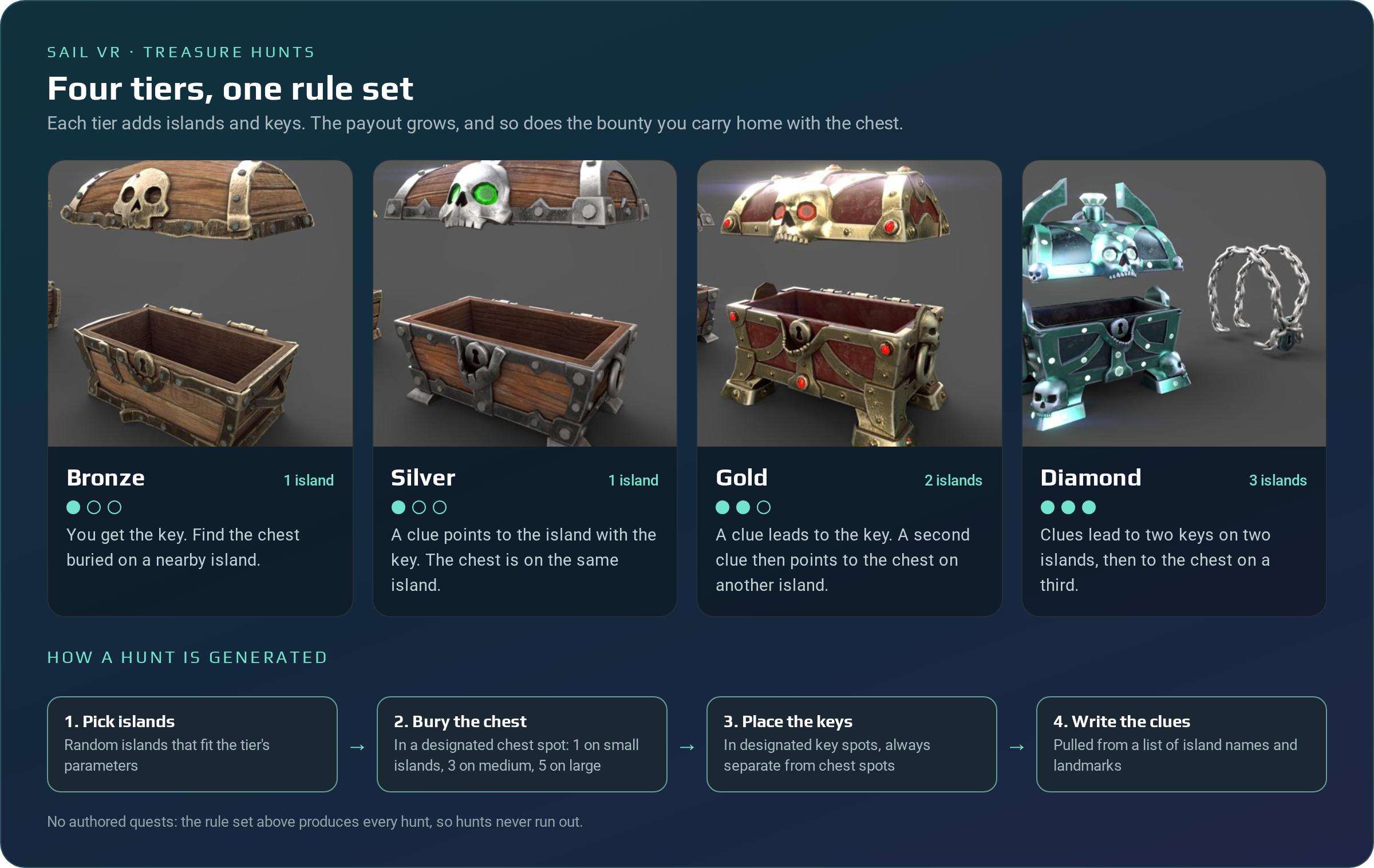
- Four tiers, one rule set. Each tier adds islands and keys:
- Bronze: You get the key and find the chest buried on a nearby island.
- Silver: A clue points to the island with the key, and the chest is on the same island.
- Gold: A clue leads to the key, then a second clue points to the chest on another island.
- Diamond: Clues lead to two keys on two islands, then to the chest on a third.
- Map prices pace progression. Early players could only afford Bronze maps. As they ranked up and earned more, the higher tiers opened up, so the size of the hunt grew with the player.
- Procedural generation. Every hunt is built in four steps:
- Pick islands that fit the tier’s parameters.
- Bury the chest in one of the island’s designated spots. Small islands had one spot, medium islands had three, and large islands had five.
- Place each key in one of the island’s designated key spots, which were always separate from the chest spots.
- Write the clues from a list of island names and landmarks.
- The chest is the bounty. Picking up the chest adds its full value to your carried gold at once, which spikes your Danger Level for the trip home. Every hunt turns into a race back to the hideout.
What worked: The tiers told players exactly what a hunt would ask of them before they bought the map, so choosing a tier meant choosing what kind of run to have. Every hunt had a distinct rhythm: a calm, focused search, then a desperate race home with the chest. The moment you dug up the chest and realized you now had to get it home alive was one of the best in the game.
What I would have done differently:
- Soften the spike after the find. The chest’s full value landed in your carried gold at once, so your Danger Level jumped the moment you picked it up. The only realistic move was to head straight home, and without strong upgrades, many players didn’t make it. That removed the choice the system was built on: push further or bank it now. The pressure valve from the Risk & Reward retrospective would have helped here too, by giving players a way to lower the heat while still carrying treasure.
- Bring back deduction at a smaller scope. The process-of-elimination clues were the right idea at the wrong scope. A simplified version, with three clues bought together at a port instead of collected across islands, would have kept the mystery without the travel time or the authoring load.